From Death to Immortality: The Great War of the Mahabharata
₹539.00

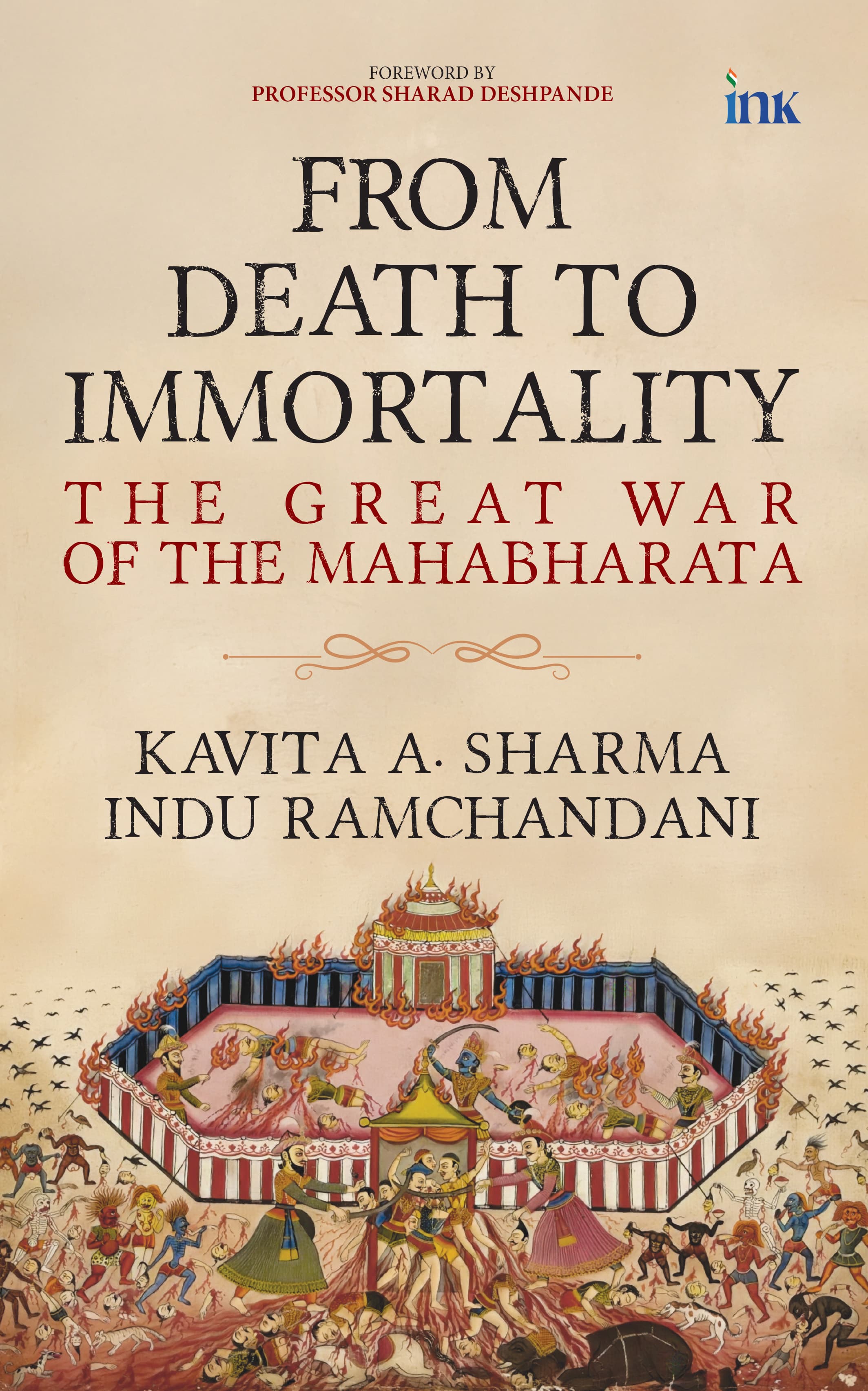
From Death to Immortality: The Great War of the Mahabharata
₹539.00
Specifications
- Language:ENGLISH
- Format: PAPERBACK
- Pages: 336 pages
- ISBN-13: 9789365471038
- Item Weight:
- Dimensions: 216x140
- Genre: History
Description
Exploring the Mahabharata reveals layers far beyond the familiar stories of war, heroism, and intrigue. This timeless epic weaves together the stark realities of human life with the mysteries of the cosmos, offering insights that remain as relevant today as they were millennia ago.



Kavita A. Sharma
"Dr Kavita A. Sharma" is an eminent scholar and renowned educationist. She served as the president of South Asian University, New Delhi, from 2014 to 2019. Prior to this, she taught at Hindu College, University of Delhi, for nearly thirty-seven years, including a decade as its principal. From 2008 to 2014, she was the director of the India International Centre, New Delhi. Dr Sharma has been awarded the Indo-Canadian Shastri Fellowship twice (1991–1992 and 2002–2003) for her research on various aspects of the Indian diaspora. She was also a Fulbright New Century Scholar (2007–2008), focusing o

“From Death to Immortality: The Great War of the Mahabharata is a thoughtful and engaging book that looks at the Mahabharata not just as a story of war but as a journey of Time, Destiny, and human duty. The authors bring a fresh insight into well-known events like Bhishma on the bed of arrows, Draupadi’s silent strength, and Krishna showing his divine form. What makes this book special is how it connects these moments to deeper questions about life, karma, and the cycle of birth and death. The book helps us understand that the ‘Great War’ of Kurukshetra was not only a battle for a kingdom but a part of a larger ‘Divine Plan’. Kavita Sharma and Indu Ramchandani invite their readers to reflect onthe meaning of dharma and the path from death to immortality in a simple and meaningful way.”
Dr Bhushan Patwardhan
PhD, FNASc, FAMS, former vice chairman, University Grants Commission; and national research professor–Ayush, Interdisciplinary School of Health Sciences, Savitribai Phule Pune University, Pune
“The Mahabharata is an ‘uncanny’ epic. Its stories promise astonishment, but its poet refuses to promise the comfort of finding a reasoned peace. Kavita Sharma and Indu Ramchandani offer a thoughtful argument that the epic has two distinctive ideas. The first is that life, however conflicted and sorrowful, has a divine plan; every thought, speech, and deed is scripted. If we accept, as Krishna does, that what we do or endure is right then we can, at the end of our days, console ourselves and say that our life has had a ‘fair reckoning’. Killed by a hunter, he recognizes that his time on earth has been a yagna, a ritualized completion. The second idea is that the Mahabharata is structured like a great cosmogonic story. It assumes that in the beginning there was a unity of purpose and a perfection of design in the universe; what the gods imagined was ethically ‘good’ and aesthetically ‘beautiful’ (Satya Yuga). Inevitably, however, the age of the gods gave way to ‘wickedness’ (Kali Yuga); the just and the unjust became ambiguous; everyday life became so predatoryband corrosive that the only way to renew the earth was to conduct an annihilatory war and begin again.”
Professor Alok Bhalla
Co-author of The Mahabharata: Mewari Miniature Paintings (1680–1698) by Allah Baksh
“Profundity and readability often seem at odds, yet From Death to Immortality: The Great War of the Mahabharata by Kavita Sharma and Indu Ramchandani defies this notion. The book delves into the idea of a righteous war within the vast, eternal, and immutable framework of existence—one that transcends time and space without a beginning or an end. Could such a war be considered the sacred duty of humankind? This conflict also embodies the threefold Purusharthas—Kama, Artha, and Dharma—ultimately culminating in the fourth, Nirvana or Moksha, the liberation from the endless cycle of birth and death. The authors state, ‘The cycle of srishti, stithi, pralaya—creation, sustenance, and dissolution or destruction—is the core of the understanding that the most ancient scriptures give us on the concept of the universe, of the planet, and of all living beings. The question that rises in the mind is, does every living being swirl ad infinitum in this cycle and go from birth to death to birth again? What then is the concept of immortality? It is the essence of Life—that existence is, consciousness is, and this ‘coming and going’ is the play of Time and Destiny; all human beings are part of the play according to their karma—actions, and the results thereof. This highest philosophy is dramatized most fascinatingly in the Mahabharata. And the truth of immortality is made evident in the narrative.’”
Anand Kumar
MD, FAMS, former senior professor and head, Department of Reproductive Biology, AIIMS, New Delhi; and former national fellow, IIAS, Shimla
“From Death to Immortality: The Great War of the Mahabharata is a thoughtful and engaging book that looks at the Mahabharata not just as a story of war but as a journey of Time, Destiny, and human duty. The authors bring a fresh insight into well-known events like Bhishma on the bed of arrows, Draupadi’s silent strength, and Krishna showing his divine form. What makes this book special is how it connects these moments to deeper questions about life, karma, and the cycle of birth and death. The book helps us understand that the ‘Great War’ of Kurukshetra was not only a battle for a kingdom but a part of a larger ‘Divine Plan’. Kavita Sharma and Indu Ramchandani invite their readers to reflect onthe meaning of dharma and the path from death to immortality in a simple and meaningful way.”
Dr Bhushan Patwardhan
PhD, FNASc, FAMS, former vice chairman, University Grants Commission; and national research professor–Ayush, Interdisciplinary School of Health Sciences, Savitribai Phule Pune University, Pune
“The Mahabharata is an ‘uncanny’ epic. Its stories promise astonishment, but its poet refuses to promise the comfort of finding a reasoned peace. Kavita Sharma and Indu Ramchandani offer a thoughtful argument that the epic has two distinctive ideas. The first is that life, however conflicted and sorrowful, has a divine plan; every thought, speech, and deed is scripted. If we accept, as Krishna does, that what we do or endure is right then we can, at the end of our days, console ourselves and say that our life has had a ‘fair reckoning’. Killed by a hunter, he recognizes that his time on earth has been a yagna, a ritualized completion. The second idea is that the Mahabharata is structured like a great cosmogonic story. It assumes that in the beginning there was a unity of purpose and a perfection of design in the universe; what the gods imagined was ethically ‘good’ and aesthetically ‘beautiful’ (Satya Yuga). Inevitably, however, the age of the gods gave way to ‘wickedness’ (Kali Yuga); the just and the unjust became ambiguous; everyday life became so predatoryband corrosive that the only way to renew the earth was to conduct an annihilatory war and begin again.”
Professor Alok Bhalla
Co-author of The Mahabharata: Mewari Miniature Paintings (1680–1698) by Allah Baksh
“Profundity and readability often seem at odds, yet From Death to Immortality: The Great War of the Mahabharata by Kavita Sharma and Indu Ramchandani defies this notion. The book delves into the idea of a righteous war within the vast, eternal, and immutable framework of existence—one that transcends time and space without a beginning or an end. Could such a war be considered the sacred duty of humankind? This conflict also embodies the threefold Purusharthas—Kama, Artha, and Dharma—ultimately culminating in the fourth, Nirvana or Moksha, the liberation from the endless cycle of birth and death. The authors state, ‘The cycle of srishti, stithi, pralaya—creation, sustenance, and dissolution or destruction—is the core of the understanding that the most ancient scriptures give us on the concept of the universe, of the planet, and of all living beings. The question that rises in the mind is, does every living being swirl ad infinitum in this cycle and go from birth to death to birth again? What then is the concept of immortality? It is the essence of Life—that existence is, consciousness is, and this ‘coming and going’ is the play of Time and Destiny; all human beings are part of the play according to their karma—actions, and the results thereof. This highest philosophy is dramatized most fascinatingly in the Mahabharata. And the truth of immortality is made evident in the narrative.’”
Anand Kumar
MD, FAMS, former senior professor and head, Department of Reproductive Biology, AIIMS, New Delhi; and former national fellow, IIAS, Shimla
“From Death to Immortality: The Great War of the Mahabharata is a thoughtful and engaging book that looks at the Mahabharata not just as a story of war but as a journey of Time, Destiny, and human duty. The authors bring a fresh insight into well-known events like Bhishma on the bed of arrows, Draupadi’s silent strength, and Krishna showing his divine form. What makes this book special is how it connects these moments to deeper questions about life, karma, and the cycle of birth and death. The book helps us understand that the ‘Great War’ of Kurukshetra was not only a battle for a kingdom but a part of a larger ‘Divine Plan’. Kavita Sharma and Indu Ramchandani invite their readers to reflect onthe meaning of dharma and the path from death to immortality in a simple and meaningful way.”
Dr Bhushan Patwardhan
PhD, FNASc, FAMS, former vice chairman, University Grants Commission; and national research professor–Ayush, Interdisciplinary School of Health Sciences, Savitribai Phule Pune University, Pune